
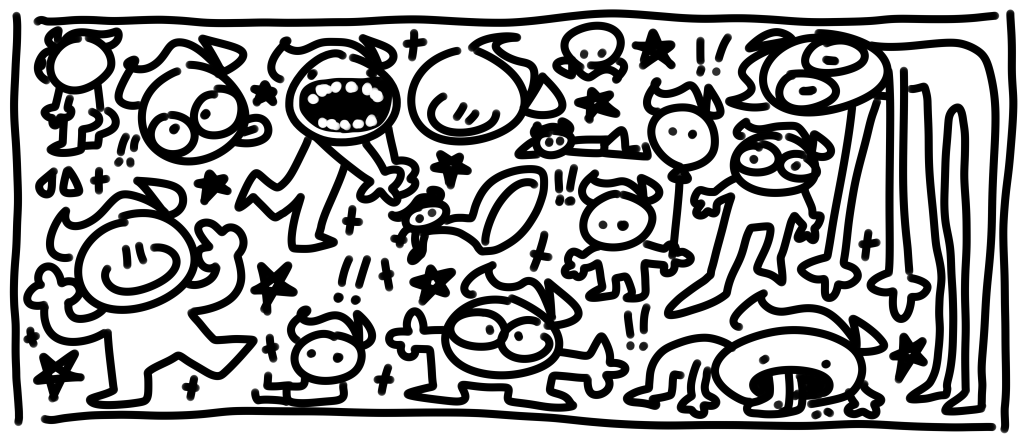
Wesleehighway is an illustrator, animator, and Communication Arts major at Virginia Commonwealth University in Richmond. I’ve gotten to know Wes over the past few years and I have always been impressed with his artistic ability, and his dedication to his craft. More than that, his stewardship of the creative communities he joins. He recently reopened commissions so I met with him to talk about finding a place making art in an indie music scene, a bit about what it’s like to try being an artist for hire in this day and age, and his experience studying abroad in Italy.
The following interview has been edited for clarity and length
Stellan: Thank you very much for taking the time to meet with me Wesleehighway. To get the interview started – you have launched commissions, how close do you feel to your professional career?
Wesleehighway: So here’s the thing right, whenever I talk about what I hope to have as my career there’s like the best case scenario dream and what’s most likely to happen. The dream here is that I would continue to be able to do this sort of like freelance thing and like take on clients and do these higher end commissions. Things pertaining to bands like merch stuff, and graphic design for like posters. Longer term stuff like animated music videos or art direction for that sort of thing.
S: So, not speculative work, but getting commissions at that higher tier.
W: Yeah exactly. That’s sort of like what I’d love to do. What’s most likely going to happen to be honest is that I take on whatever job lets me do art and pays me at the same time. That’s sort of where I’m at. I have sort of dipped my toes into the world of being able to do like band stuff because I did at a certain point, I think like 2 years ago, a merch design for a friend of mine in the band Phoneboy. It got all the way to the end, but it never got launched officially because… The official reason is that it didn’t, ya know, fit the aesthetic of the current merch line, but I’m sure there were very many reasons why it didn’t really get off the ground.
S: Operational reasons?
W: Yeah. I’m kind of in like a nebulous area I guess where I have sort of that like experience of what I would like to continue doing, but I haven’t like officially made a product in that field.
S: How do you feel about the idea of speculative work? The portion of your career that is doing it before anyone pays you?
W: I mean I don’t know it’s like on one hand. You should always get paid for your work you should never work for free. On the same time the kind of work I do there’s so much of it where the experience is so valuable. The whole pipeline of communicating with someone and going back and forth and talking about what is the end goal? Making sure we’re on the same page, being able to receive feedback and take all that critique. I feel like that’s very valuable and everyone should be able to got through that. At the same time it does feel bad to essentially do work for free. I don’t know Even though that merch design never got launched I still think that it was a very valuable experience and I’m able to go to employers and say: “I’ve worked with this sort of thing. I have experience with this sort of thing”
S: So let’s talk a little bit more about Phoneboy. Can you describe a little bit more your relationship with them? Of the people that I know, you are the closest to other indie artists. How did you get into that position, and what have you gotten out of it creatively?
W: So it’s quite a long and convoluted story. It actually started with a different band who I am not a huge fan of anymore who I won’t name. They did introduce me to Phoneboy which was pretty cool. Yes, I was a very big fan of phoneboy before getting to know anyone from the band, but I wasn’t every like “Oh my god I’m best friends with the band!” and they never knew who I was. It was very much interacting with the community and then the natural progression of things was talking to the individual members more and more. Specifically, Ricky and Wynn who I think I’m the closest to I guess, but ya know I wouldn’t consider us best friends or anything, but we’re like people who get along and talk about things outside the band and stuff.
S: And not to maybe throw you under the bus with this parasocial thing, but this happened mostly on Discord right?
W: I guess, but it was also a lot of like talking to them in person at shows and stuff so it was a lot of in the moment before and after a show I would see one of the members be like “Hey” or “What’s up” and then we would chat for a little bit.
S: So would you say that the at show interactions mattered more than the ones that happened online?
W: Oh yeah for sure.
S: You mentioned that you worked with them on this speculative merch design. I also know that you’ve drawn the members of Phoneboy fairly regularly.
W: Yeah not as much anymore, but that was something I enjoyed a lot more when I was first getting into their music.
S: That was just like a fan art sort of thing.
W: Yeah
S: I also noticed that you drew four of their songs as hot girls.
W: yeah I loved doing that. That was great, that was super cool.
S: You mentioned that the merch design thing is good for employers, but how much of the fan art are you able to use to sell yourself because I know that, or I hear, that isn’t the kind of thing people tell you to put on portfolios.
W: I think that the fan art thing – this is all like my personal understanding of it – I think people are very divisive on it but I think that there’s a correct an incorrect way to go about it. Like that series I did of Phoneboy songs as girls, the music itself has no visuals to it, so I’m taking something from one media and translating it to a visual art, so that’s, I think that’s pretty different to making a Hazbin Hotel OC.
S: Yeah, that’s more in line with traditional art practice. Speaking of which, You studied in Italy?
W: I did, Yes.
S: What was that like because whenever I hear, on the music side, about people going off to study in Europe there’s a specific connotation to it and that’s sort of what I also got from hearing about you going off to Italy for a summer.
W: So I’m about to talk a lot of shit about that program. To be perfectly honest I hate the professor that was heading that program. He is a freaking weirdo and, I do not like him. One of the things that almost made me not apply to the program was the fact that he was the one leading the program, but anyways. It was organized very strangely I would say. We didn’t have any class time per se, and there was never attendance that was taken, but we would have an itinerary throughout the week of like: We’re going to these places together. We’re going to these museum, our tickets have been paid for. We took a couple day trips to… I think it was Milan, Pisa, and a third place I can’t quite remember. We were primarily in Florence, but I think one of the strangest things was that we were given a list of artwork that we were supposed to do studies of from observation, supposedly, and there were certain pieces of art on that list that we never saw. Some were in the Vatican city, or in Rome and we just never went there. So you would end up getting home at the end of the day and looking up the pieces of art on google and then doing your studies that way. Ok then like why did I come to Italy!? That was definitely one of the biggest things that irked me. In general it was a pretty nice trip. Florence specifically, there’s so much art everywhere. The architecture. You walk down the street and there’s a fountain that was made by whatever prolific artist at the time, and it was a very enriching experience I guess. I don’t know. I think the way it was handled on the administrative side was not very well done, but I had a good time. I saw a lot of cool art, made some cool art, and I got to go to the beach with my friends on the weekends. So that’s cool.
S: Nice. So when you said you were surrounded by art, I assume you specifically mean sculptures, and that fountain you mentioned. Was there any art that was actively happening, or did you go to Italy to see all the art that’s public?
W: Something interesting about the specific place and time that we went because we were in Florence in June. The whole month of June I’m pretty sure. There were a whole bunch of students doing art trips to the same places we were at. We ran into different groups of students. There was one time, I was having breakfast with my friends, we were outside a store sketching or something. There was a group of like, I wanna say German, students and they were about our age. They were like “Where are you from what are you doing?” One experience my friends always reference: I was showing one of them sketches from my notebook and I was flipping through, and this guy next to me goes “Oh mein gott!” and something about that really made me and my friends laugh. It was pretty cool. We got to see some of their work too. Since they were architecture students they were doing very rigid line and shape studies which is very different from what we’re doing when we’re doing anatomy studies of statues and stuff. It was cool to see them do basically the same thing that we’re doing which is like going out and drawing from observation, but its so different in the sense that I don’t think I could do what they were doing and I don’t think they could do what we were doing.
S: So there was a verve in the city, but nothing to do with the people who usually live there but just getting to meet all these peers who were also going to study in Italy.
W: Yeah. And also, the last day that I was in Florence there was a brochure for an orchestra that spontaneously took place in an outdoor fenced in area with a bunch of statues and they just had an orchestra there that was free to go see. It was, I wanna say, the Hong Kong youth orchestra. It was super cool because it was the end of the day, the sun was going down, we had just left the museum, and I heard the sound of a bunch of string instruments warming up and on my way back to my apartment we saw all these people setting up. We kinda just sat down there and got to enjoy a very cool show. I was like “wow. there’s so much going on here.” It was a very nice end to the trip.
S: Before you went on this trip did you have any expectations? How was it sold to you?
W: That is a good question considering I didn’t know a lot about the trip going into it. I will be completely honest the main draw was that it was a 5 week program and I would be getting 6 credits out of it. Hey I get to go to Italy for 5 weeks and then I get 6 credits out of it. That a pretty good deal to me.
S: Choosing to do art in college is kinda weird. I know that it took me a while that it’s what I wanted to do and that I was allowed to do it and then I had to have that conversation with my parents. What was that like for you?
W: I am very very lucky in the sense that my parents are very supportive of what I do and I’m also very lucky in the sense that my two older brothers are pretty successful so I, as ya know me being the third youngest child. I think there was an element of my parents being: you can be more free to do something less professional I guess. My parents have very different philosophies on how I should lead my life but they both agree that if I am actively working toward a goal they will support that goal. I had been doing art forever, since elementary school. I’ve always loved art; I always hated math and science. I was terrible at it. From a very early age I was like: “I wanna do art. I don’t wanna do anything else all I wanna do is art” Then sometime in high school I had a crisis. “I can’t do art! I’m gonna starve. I can’t do art, I can’t be an artist, it’s not gonna work out. I’m gonna be a teacher.” Which is like, ya know, cool I guess, then a few weeks later I cooled off and realized: It’s not that serious. I actually do want to be an artist. It took a lot of talking to my parents. Outlining, being perfectly honest, and saying I don’t know exactly what specific career I want, but I know that I want to go to school for art. My parents, specifically my Mom, was supportive in that fact that she said: if this is what you want to do and you think that college won’t be conducive to this goal then maybe you don’t have to go to college. I ended up going to college anyway, but it was nice that was an option that was there for me. I definitely think I am here because of a very lucky combination of circumstances, and I feel grateful that I’m able to be in this position where I am going to art school and my parents are supportive of it.
S: That makes it sound like, in college, part of the process was discovering what your future career might be. What has that journey been like? Now you have this idea of music related art. Art connected to the music industry or merch. How did you get from “I don’t really know what my career is going to be” to there.
W: I had this vague idea going into college that I wanted to do animation and concept design for characters and stuff. Which, first of all, my school didn’t even have an animation program when I applied here so I don’t know what I was thinking. It was really just a product of going to live shows and becoming more connect to music communities and I had this moment that I could do art for music. Specifically there is an artist, her name is Alex Kitchmire, and she was my idol in my freshman year. She did everything that I wanted to do. She became friends with a band I was really into at the time, and she did merch designs for them. She did animated music videos for them; she painted sets for their live action music videos; she did graphic design for their festival backdrops. I was like: “Dude, that’s… I wanna do that. I would love to do that.” So that’s sort of where I got the inspiration from. Then as I took more classes, I took typography and graphic design classes that were required by my major. I learned more about graphic design. It really reinforced my want. This is where I wanna be. This is so cool; it’s what I wanna do. I really enjoy this. Honestly it was a lot me getting really into music my freshman year.
S: So having access to this community of music and art for music is what brought you to wanting to do that. What was the experience of getting into that community before you knew you wanted it?
W: I think it was basically me hyper fixating on one band for a year and becoming active in their community. I listened to all their music. I watched all their music videos. I would go to the credits and see who worked on the music videos. I’m pretty sure I got to talk to Alex a couple of years ago. I asked her how she got into doing ar t for that band. She said it was a matter of circumstance. They reached out to her after noticing that she had been doing fan art of them for a while, and wanted her to do official art for them. So it was basically getting super into this band and then wanting to know everything about them and along the way I learned about Alex and it was super cool.
S: Sort of following the thing you were enjoying and then finding the people and asking them directly?
W: Yeah pretty much?
S: You’ve opened commissions. What made you decide to do that?
W: It’s sort of been something that I’ve wanted to do for a while. I think that the last time I officially opened commissions was in high school or something. It was pretty successful back then, but going into my senior year I wanted to be more on top of my own money and wanting more experience with communicating with clients and doing art for money. There wasn’t a very specific reason why I chose this time of the year. I just had nothing else going on. I finally can sit down and work on this, and open my commissions again.
S: What are your goals with commissions? Seeing as you’ve done it before when, I think it’s fair to say you were much less experienced, so starting it up again what do you think are the main points of difference?
W: I have two goals with my commissions. First of all, I want to make money. I like having money. Second goal is that I want more experience drawing in general. I don’t think I’m going to put any of my commission art in my portfolio or anything, but I have an easier time making art if it’s for something. Between art for class and art for a friend, it’s a little harder when I don’t have a deadline and I’m just like: “I feel like drawing today.” Then the drawing never gets done. It’s nice to have someone to be like: “Hey, I want this artwork, and I want it done by this date.” Ok. I can lock in. That is doable for me.
S: How has the launch gone so far? I noticed that you had to set up your terms of service. You added it to your card, your online business card. How much of all that did you have to change to prepare for this?
W: My commissions terms of service have actually been on my card since High School. It wasn’t completely updated so I did have to tweak some things. I had to add some text, remove some text. I think the last time I updated it was sometime during the spring semester last year. I took this class that was all about how to do industry work. Part of that class was learning how to write a contract, and what you should included when you’re doing art for people, so I added some stuff to my terms of service, but at that point commissions weren’t open. Basically I just had to make my commissions sheet, which was honestly the hardest part, it took me so long to put up the example art on there. Luckily, the drawings that I used for my commissions sheet, the sketches came from other projects I was working on so I didn’t have to come up with a whole new illustration, I could just steal from projects that never really got finished. It was basically: making the commissions sheet, setting my prices, updating my terms of service, and then I posted it on Instagram which is my main platform and that’s basically it. The longest part really was making the example illustrations.
S: What was the calculus behind: these are my prices, this is what I’m worth, this is what makes sense to ask for?
W: It really is arbitrary. The biggest thing is that I factor in how much effort and time it takes to make each illustration. I think specifically for the first style that I offer, which is a more detailed rendered style, the price really goes up between flat colors and renders because that style of renders takes so much time. There’s no way that I’m gonna undersell myself for this. If I am going to be making art for people like this I’m going to need to be paid for what it’s worth. For the second style I was a bit more: “ehh, this is a good price I guess.” Also the prices on my commission sheet are intentionally a little high because I want people to read my terms of service. It is important to me that you understand what you can and can’t do with my art once you’ve bought it from me. Also, I just think it’s important if you’re buying a product from someone that you read the terms of service. It’s important information for my clients to know. It has what my turnaround time is, and what you can expect. All this sort of stuff. I learned this back in High School when I started doing commissions. I have this little line of text that’s hidden in the middle of my terms of service that says “hey, thank you for reading my terms of service. Message me this and I’ll give you a discount on my prices.” Because, basically, how it works is that there’s a fee if you don’t read my terms of service because the discounted prices are my actual prices. What’s on the commission sheet is the price if you don’t read my terms of service.
S: I’m also thinking about, maybe in the past you would be more interested in getting a “real art job” and this commissions price structure is very theory of labor, this is how much effort it takes. Whereas, getting commissioned by a magazine, that still factors in, but your pay is connected to what portion of the profit of each magazine can be allocated to the art assets. Do you feel any difference in the future of you career between being apart of someone else’s project and providing your own art on commission?
W: Yeah, I’m sure it is very different. All of my knowledge of real industry work comes from that class that I took last spring. My professor literally broke down how he prices his artwork because he does exactly that. I think he did artwork for Rolling Stones and magazines like that, so he went thorough how he prices his artwork and communicates that to his clients. It’s definitely very different than me being like: “If you want a full body drawing of your OC it’s this much money” ya know? I don’t know I have no experience doing that sort of thing, so I’ll get to it when I get to it I guess.
S: Did that class give you a positive outlook on that direction your career could go?
W: The class itself was pretty informative. I was not a big fan of my professor.
S: Could you expound upon that a little?
W: He was an old white dude so a lot of his lessons were basically. I don’t wanna sound like, whatever, but it was kinda like a boomer take where he would say: “you just gotta go in there and talk to the CEO and hand in your portfolio with all your traditional drawings.” Demand an interview with them and sit down and do this whole thing. It’s like I’m sure that worked like 20 or 30 years ago, but I don’t know how successful that is nowadays. I don’t know maybe it is. Maybe I’m just talking out of my ass. To me a lot of his advice he had about getting started was more successful when he was growing up, and not applicable to new artists in this day and age. It was a lot of him like: “You just gotta do this thing, and start your own company, and build your own website.” It’s like that’s not very approachable for many students in this day and age I feel.
S: So you feel your professor was a little alienated from the realities of today?
W: Yeah.
S: Of that, has any of that advice stuck? Even with the boomer takes, has anything stuck in your brain and you understand maybe why he would say that even now?
W: I say all that, but I think it was very admirable that he was able to do all these things and build his company from the ground up. I found that very inspiring even though I don’t think that super feasible for people like me. The general message: if something doesn’t work, try something else, always be putting effort into something, was very helpful and inspiring.
S: Maybe the attitude is aspiration, but the landscape is so different maybe for him it was starting a company and for you its commissions and speculative work as opposed to getting employees or whatever he was doing.
W: Yeah, who am I gonna employ?
S: Do you think using a still image from Smash season 1 episode 15 as a pfp contributes to your online brand? If in what way.
W: Ok so some context behind my pfp, first of all. My name is Wesley. The person in my pfp is named Wesley Taylor. He’s like one of my favorite people of all time. That show that he’s in – pretty bad. It’s like one of those show that you watch where you have to turn your brain off. It did not get renewed for a second season. I think for a good reason. The show is not very good.
I started using that profile back in high school. It started as a one off thing. that screenshot is actually part of a bigger scene that’s dressed similarly. I had matching pfps with someone else and that was my portion of the image because I love Wesley Taylor. It kinda just stuck because I started using it as my pfp for all of my different accounts. I have this friend who is a year older than me and she went to school for marketing and business. She always said: “If you’re trying to grow your online brand you’ve gotta have a distinct profile picture” It was really funny actually. She didn’t like that my Valorant username wasn’t Wesleehighway. “You gotta have a consistent brand!” I was like I don’t think it’s that deep actually. Maybe it is. It might be sort of a fumble on my part to get so attached to this image that isn’t me.
S: And is copyrighted in ways that aren’t accessible to you?
W: Yeah I get very sentimentally attached to things easily so I’m reluctant to change it. I’m sure some point down the line if I get in trouble for using it I’ll change it. I think it’s an example of one of my main interests. For the most part I’m just doing stuff for fun.
S: You said a few times ad copy “I’m just one guy” I can’t help but read “I’m just one little guy” in between the lines. Is that “I’m just a little guy” what you’re going for with your online brand? Or am I being diminutive?
W: No I think that’s pretty accurate. I’m not a big company, I’m just one guy. For the most part I am just doing stuff for the love of the game. A lot of the art I enjoy doing is fan art or my original character that I like to tell silly stories with. Even from the beginning I do artwork because I like it not because I have some mastermind end goal. I also think it’s a good way of breaking down the barrier. I’m sort of getting to the point where people talk to me and they’re like… I’ll go to shows or something and someone will come up to me and say: “Are you Wesleehighway?” I guess I… am! I don’t know that sort of thing stresses me out. I think saying that I’m just one guy is a good.
S: I get the impression that you think that changing in order to give an outward appearance of professionalism might alienate your current audience?
W: I guess. I am willing to sacrifice that bit of professionalism so that other people don’t seem me as an otherworldly authoritative figure.
S: What can we expect next from the incredible Wesleehighway?
W: I don’t know, I guess I don’t really have anything huge planned besides content creator stuff I want to do with my friends. That’s the big project I’m working towards. My senior year has started. I don’t have anything crazy planned. I have some animations finished that I haven’t posted because I don’t really like how they look. I would like to do more animation stuff. That’s about it. I don’t have a like: “I’m staring in the next Dune movie!!”


Leave a Reply