
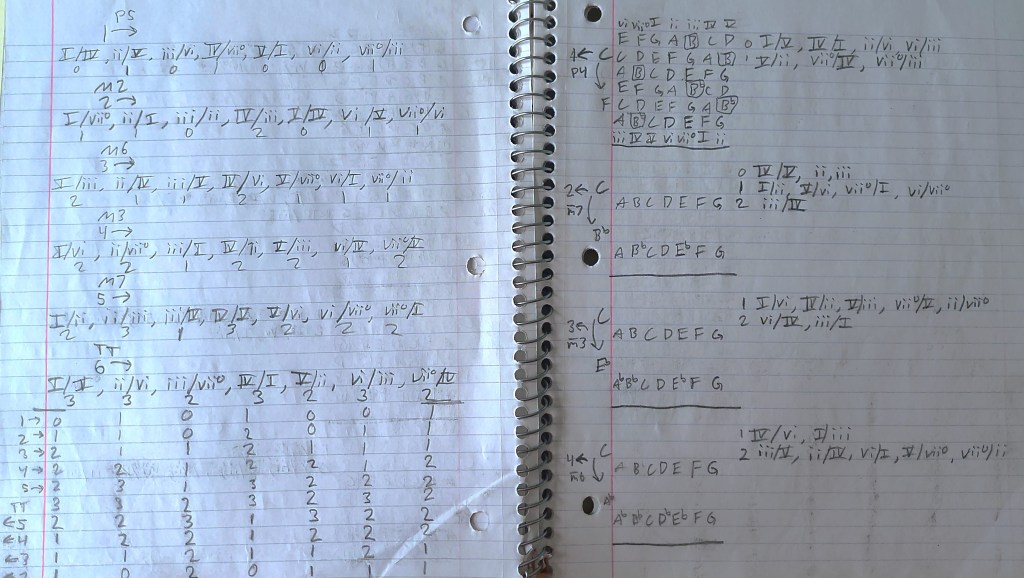
Despite entering my undergrad in 2021, middle of the pandemic, the only things I was infected with when I began my education was pride and delusion.I entered college with the false belief that I was there to become great. That through my classes I would attain the requisite knowledge to be someone who would have a place in the canon, someone worth discussing after my death. Because of this mental miscalibration I perused what I though was important. I tried to INVENT SOMETHING. A new theoretical model for composition that could, one day, be studied in the very theory classes I was still taking. I knew too little to realize how stupid I was being. I’m being a little mean in the retelling of this story, but if anyone has an obligation to be a little mean to 18 year old me it is current me.
The thing I managed to INVENT was a way to visualize layering keys over each other. That is to say, by writing out the notes of each chord in both keys and then drawing boxes around the notes of each chord pair that didn’t match you could see the conflicting notes in each chord. The boxes made it look like a game of hopscotch so I started calling these Hopscotch Diagrams. The diagram can then be used to order the order the chords by number of conflicting pitches. It also made clear which pitch or pitches needed to be emphasized in order to bring out the clashing of the two keys. The piece I wrote after “developing” this “system” – Visage – is the subject of this post.
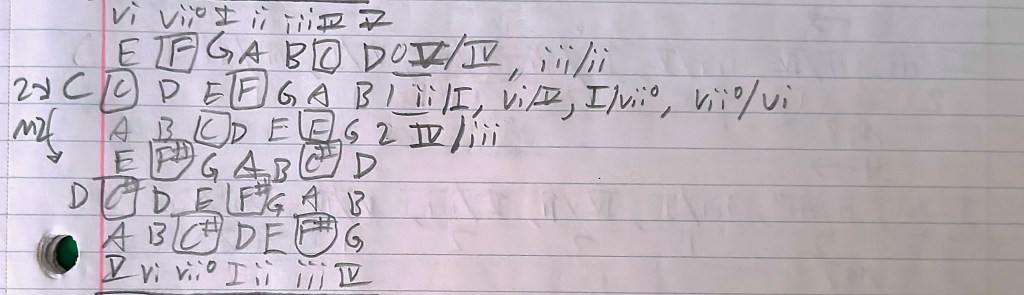
So what’s the actual problem here? Like I said before I was being kinda stupid. I had failed to INVENT SOMETHING (although I wouldn’t really internalize that for an embarrassingly long time) and that failure I had done something more interesting. I had invented a thing, a tool! I didn’t expand human musical knowledge or contributed to some revolution. I had merely helped myself to learn how to solve a compositional problem. It solved the basest and most scary problem every composer faces in every project: “what even, fuckin’, notes should I use?” It also solved the problem that I didn’t want to write purely tonal music. Two reasons for that: Firstly, it is hard and scary and people can tell if you do it badly. Secondly, tonal music is old and can therefore be ignored as an aesthetic model. I was yet to learn that all the weird non-tonal music is also old now.
This tool which I created and used to solve problems felt entirely my own in a way. The problem with that feeling is that I had failed to recognize where my influences were coming from, and failed to look in the direction of other people doing the same thing as me. I, unconsciously at the time, got my idea of ordering collections of pitches by dissonance and then progressing through them from Hindemith by way of Persichetti because I had read 20th Century Harmony in high school. I also didn’t take it upon myself to ask my professors or use my music library and the attending music librarians to find examples of composers who had already figured out poly-tonality. I studied no scores; I asked no questions. It was fun, and probably an important mistake to make in the way I did, if only because the current me finds it so cringy as to hope desperately I never repeat it.

To move on to the piece itself, I wrote this Sax Quartet for the simple reason that I was in a Sax Quartet and my Saxophone Professor wanted the ensemble to be available to me to experiment on. I’ve included the score for the perusal of any interested readers. I could go phrase by phrase and try to explain all the choices, but that work would be largely reconstructive. I have no sketches or notes from writing this because at the time composition was still something I did linearly, somewhat improvisational, and rushing to meet deadlines by working through the night while sitting in the laundry room of my freshman dorm. It is also the first piece I wrote in college. There’s not much there. I was mostly experimenting with four part texture and trying to use my hopscotch diagram.
The more important thing I learned from this experience was working with an actual ensemble. I was thankful they were playing my music. It’s good to be thankful. I was of course insecure about the whole ordeal, but if I can give my younger self some credit, I don’t remember acting particularly insecure. I tried my best to fill the role of composer and answer questions and direct. It was a role don’t yet understand, and understood less at the time. I count myself lucky that in my youth I realized that all confidence is a performance because your confidence exists only in the eyes of others. You can lie, and if you lie well enough given the stakes of the situation, the lie becomes real.
Anyway, working with the ensemble I realize two things. One the midpoint of the piece didn’t work. Two I needed to spend more time thinking about how I wanted the piece to sound. The first one was easy — I changed some chords around — but the second one began the long train of realizing that it was my job as a composer to answer as many questions as possible in the score itself. I realized, but can’t say I fully internalized, that it was my responsibility to make every possible decision about dynamics, articulation, etc. because if I didn’t make the decision then there wasn’t an answer. Rather, there wasn’t an answer for the people who needed it (the ensemble very kindly spending their finite time on my music) when they needed the answer (immediately).
I am not a genius. It is not any failure of my personality or a failure of my institution of learning that I wasn’t molded into a genius by my time studying music. Becoming a genius was never the goal. I don’t personally believe that the point of art is immortality, but even if it was, the purpose of art education definitely isn’t to teach you how to be immortal. I believe that the goal of my education was to teach me how to build use and build tools in order to help people, fellow musicians. I didn’t learn for the future, which does not exist. I learned so that in my now I can solve problems and make decisions for others, and, if I am so lucky as to gather people around me to create music with I will keep those people around by being an effective composer, not a genius composer. If such a thing even really exists.


Leave a Reply